

Nilüfer Orthodontics: Dental Crowding and Current Treatment Methods
A healthy oral structure requires teeth to be properly aligned on the jawbone and the upper and lower jaws to close in harmony with each other. Crowding, spacing, or irregularities in jaw relationships are not merely conditions that affect appearance. Such bite disorders (malocclusion) can make chewing difficult, cause speech disorders, lead to temporomandibular joint problems, and increase cavities and gum disease due to the difficulty of cleaning the teeth. The orthodontic services that stand out in clinical practice in the Bursa Nilüfer region aim to diagnose these functional and anatomical problems in both children and adults and offer personalized treatment plans.
What Is Orthodontics and When Is It Recommended?
Orthodontics is the branch of dentistry that examines, prevents, and corrects the relationships of teeth, dental arches, and jaws, as well as developmental or acquired disorders affecting them. The main goal of orthodontic treatment is to achieve ideal aesthetic and functional occlusion by moving the teeth within the biological limits of the jawbone.
This field, commonly known among the public as "braces treatment," is evaluated in the presence of the following clinical conditions:
Crowding: When the jawbone is narrower than the width of the teeth, causing the teeth to overlap or erupt rotated.
Spaced Teeth (Diastema): The presence of more space than normal between teeth.
Anterior Crossbite: When the upper front teeth are positioned behind the lower front teeth, or there is a reverse bite in the back teeth.
Deep Bite: The upper front teeth cover the lower front teeth more than they should.
Open Bite: When there is a gap between the front teeth while the back teeth are together and they do not touch.
Impacted Teeth: Teeth, especially canines, that remain within the jawbone and cannot erupt into their normal position.
Current Orthodontic Treatment Methods
With advances in technology, the variety of materials and techniques used in orthodontics has increased. The choice of method is determined by the severity of the problem, the patient's age, expectations, and the clinician's assessment.
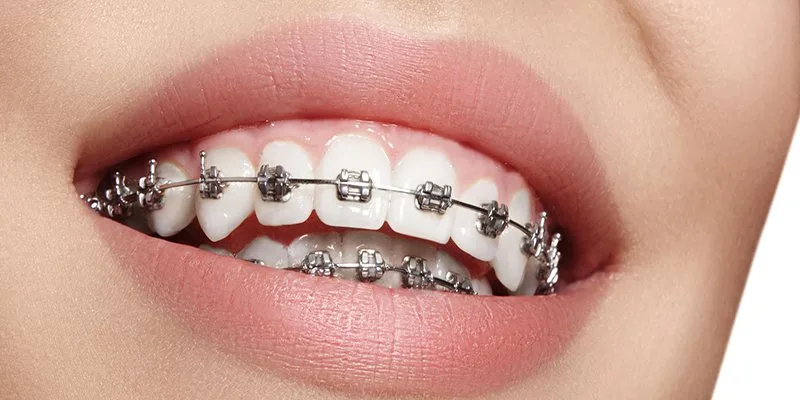
1. Metal Brackets (Traditional Braces)
It is the oldest and most durable treatment method in the history of orthodontics. Forces are applied to the teeth through stainless steel brackets bonded to the front surfaces of the teeth and archwires passing through these brackets. It offers a high degree of control, especially in solving complex and advanced skeletal or dental problems.
2. Aesthetic (Porcelain or Sapphire) Brackets
These are appliances developed for patients bothered by the appearance of metal brackets, made from tooth-colored or transparent ceramic material. Their working mechanism is the same as metal brackets, but they are less noticeable from the outside.
3. Clear Aligners (Braceless Orthodontics / Aligners)
These removable orthodontic appliances have become increasingly common in recent years among adult and teenage patients. With the help of digital intraoral scans, the patient's oral structure is transferred to a 3D environment, and a series of clear aligners is produced to gradually move the teeth. The aligners can be removed while eating or brushing the teeth. This makes it easier to maintain oral hygiene during treatment and offers an aesthetic alternative in social life.
4. Lingual Orthodontics (Invisible Braces)
This method places the brackets and wires on the inner surfaces of the teeth, facing the tongue, instead of the outer surfaces. From the outside, the presence of the treatment is completely hidden. Because the anatomical structure of the inner surfaces is unique to each person, lingual brackets usually require custom laboratory fabrication.
How Does the Orthodontic Treatment Process Progress?
Orthodontic treatment is a long-term process that requires disciplined follow-up and patient compliance. The process generally consists of the following steps:
Initial Examination and Diagnosis
The dentist performs intraoral and extraoral examinations. Panoramic and cephalometric X-rays are taken to evaluate the angulations of the jawbones and the condition of the tooth roots. Intraoral photographs and digital impressions are taken to confirm the diagnosis.
Planning and Preparation
Before starting treatment, all cavities in the mouth must be treated, tartar must be removed, and extraction decisions must be made if necessary. After the oral tissues have been made completely healthy, the brackets are bonded or the clear aligners are delivered to the patient according to the chosen orthodontic method.
Check-up Sessions
In fixed brace treatments, routine check-ups are usually carried out every 4 to 6 weeks. During these sessions, the wires are changed, elastics are attached, or new forces are applied. In clear aligner treatments, the patient changes the aligners themselves according to the schedule set by the dentist (usually every 7-10 days) and is called in for clinical check-ups at specific intervals.
Retention Treatment
Once the teeth have reached their ideal positions and the brackets/aligners have been removed, the treatment is not considered complete. It takes time for the bone and fibrous tissues around the teeth to adapt to the new position. To prevent the teeth from moving back to their прежни places (relapse), a thin stabilizing wire (retainer) is bonded to the inner surfaces of the teeth, or night retainers are used. The retention phase plays a role at least as critical as active treatment in preserving the achieved result for life.
Is There an Age Limit for Orthodontic Treatment?
One of the common misconceptions about orthodontic treatments is that they can only be performed during childhood or adolescence.
Orthodontics in Children: The Turkish Orthodontic Society and international organizations recommend that children's first orthodontic examination be carried out at around 7 years of age. At this age, primary teeth and permanent teeth are present together, and possible discrepancies in jaw development (for example, the lower jaw being forward or backward) can be guided without surgery using preventive orthodontic appliances.
Orthodontics in Adults: As long as a healthy jawbone and gum tissue are present, orthodontic treatment can be applied at any age without any age limit. Although bone movement occurs somewhat more slowly in adults than in children, the functional and aesthetic results achieved are highly successful.
Oral Care and Nutrition Recommendations During Treatment
In individuals wearing braces, the area around the brackets creates favorable spaces for food debris and plaque to accumulate. Inadequate oral care can lead to gum swelling, bleeding, and permanent white spot lesions around the brackets (decalcification) when the braces are removed.
Interdental Brush and Special Floss: In addition to regular tooth brushing, small interdental brushes and floss threaders must definitely be used to clean between the brackets.
Oral Irrigator: Pressurized water flossers make it much easier to mechanically remove food debris trapped between the wires.
Dietary Restrictions: Patients undergoing fixed brace treatment are advised not to bite into hard foods such as shelled hazelnuts and walnuts, and to eat fruits such as olives and plums after removing the pits. In addition, avoiding sticky foods such as Turkish delight and gum, as well as acidic drinks, helps prevent brackets from breaking off.
Conclusion
Nilüfer orthodontic treatments aim to protect oral health by correcting dental alignment problems and jaw disharmony with evidence-based methods. Properly aligned teeth not only provide an aesthetic appearance; they also create effective chewing, comfortable speech, and an oral environment that is easy to clean. Suitable orthodontic solution options are available for individuals of all ages, and early diagnosis and regular specialist follow-up are the most important factors in treatment success.